Something that a lot of people don’t know about my hubby, Mike, is that’s he’s colour blind. So, for Valentine’s day this year, I decided to get him another pair of EnChroma glasses. This post isn’t about his reaction, (you can see that here). Instead, it’s about how they work.
What Are They?
EnChroma glasses are very fascinating. The people who use them are color blind and when put on, the glasses help see in color. When people put on the glasses for the first time, most of them have never seen in full colour. It’s usually a very emotional experience. When I bought Mike his first pair, he burst out into tears.
How Do They Work?
In the back of your eyes there are cones and rods. There are three cones and each have one color that they absorb. The three colors are blue, red, and green. Each cone picks up different colors with the waves that go through them. Most color blind people are not missing a cone, however, usually two of the cones overlap and are almost identical, making it harder to distinguish between colours. The rods pick up on light and dark. When the glasses are put on they only let in the primary colors and reflect the complimentary colors. By only letting in the primary color they are able to see clearly and helps them see the other colors. The glasses only allow some frequencies in because the glasses need to allow the peoples eyes to adjust.
The complimentary colors form when a primary color and a secondary color combine to make white. The lens on the glasses refract light at different angles when light is travelling in straight parallel lines pass through them. The glasses use different wavelengths to help people eyes adapt and see the colors around them
Light waves move at the speed of light or 299,792,458 meters per second which is faster than the speed of sound. When light waves hit or go through a medium, such as a glass of water, the waves slow down and when they exit the medium, they speed back up. This is called refraction. This applies to EnChroma glasses because the glass in the glasses act as a medium slowing the waves down.
How Light Works
When light bounces off a surface at the exact same angle that it hit the surface, it is called reflection. There are two types of reflection: regular reflection and diffuse reflection. Regular reflection produces a reflected image. This happens when the surface is completely smooth- mirrors or glass, for example. Meanwhile, diffuse reflection happens in all other objects. It does not produce a reflected image because the reflected rays scatter arbitrarily.
Refraction happens when light changes speed and wavelength (often resulting in a change of direction) because it moves from one medium to another. Light always travels in a straight line unless it is interfered with by another object.
Absorption happens when light energy does not reflect off the surface of a substance, but is instead absorbed and converted into thermal energy.
When an object is white, it reflects all light, but when an object is black, it absorbs all light. For example, if your shirt is blue, it is absorbing all colours except blue, instead reflecting blue.
Light is compromised into seven different types on the Electromagnetic Spectrum (EMS): radio waves, microwaves, infrared light, visible light, ultraviolet light, x-ray, and gamma rays. The human eye is only able to see visible light. On the EM Spectrum, visible light lies between infrared light and ultraviolet light in the middle of the spectrum. Each colour has a different wavelength, while its brightness is determined by the light wave’s amplitude. The greater the amplitude, the brighter the light. Distance from a light source can also affect its brightness.
Visible light is compromised into seven different colours: red, orange, yellow, green, blue, indigo, and violet. Violet has the highest frequency while red has the lowest frequency. Shorter waves have have a higher frequency and contain more energy, while longer waves have a lower frequency and less energy.
If all colours are combined, the produce white light. When white light is shun through a prism, it produces the visible light spectrum, in other words, it shows all colours. This is because the light refracts when it is shone through, slowing the wavelengths into each colour.
Light travels in waves. The highest point of a wave is called the crest, while the lowest point of a wave is called the trough. The wavelength is the distance between successive crests or troughs and measures one complete wave. The amplitude is the height of a wave measured to the position of the equilibrium.
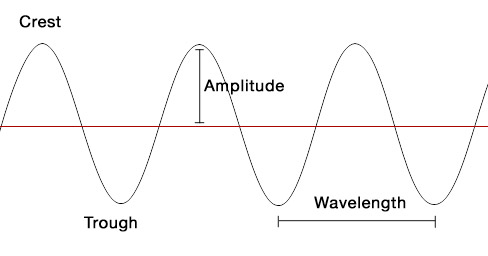
The number of crests of a wave that moves past a given point in a given unit of time is the frequency. In other words, it is how often the wave crosses the equilibrium. The frequency is measured in Hertz and the higher the frequency, the more times the wave crosses.
The speed of a wave varies depending on the medium. The less matter there is, the faster a light wave travels. It is the opposite for sound waves, however. For sound waves, as matter increases, the speed of the wave increases. Light waves can travel through a medium, or through outer space where no mediums exist. Unlike light waves, however, sound waves need a medium to transmit. This is why there is no sound in space. Light waves always travel faster than sound waves. Even the fastest sound wave is much slower than the slowest light wave.
 Chatty Cathy's Cranberry Site